
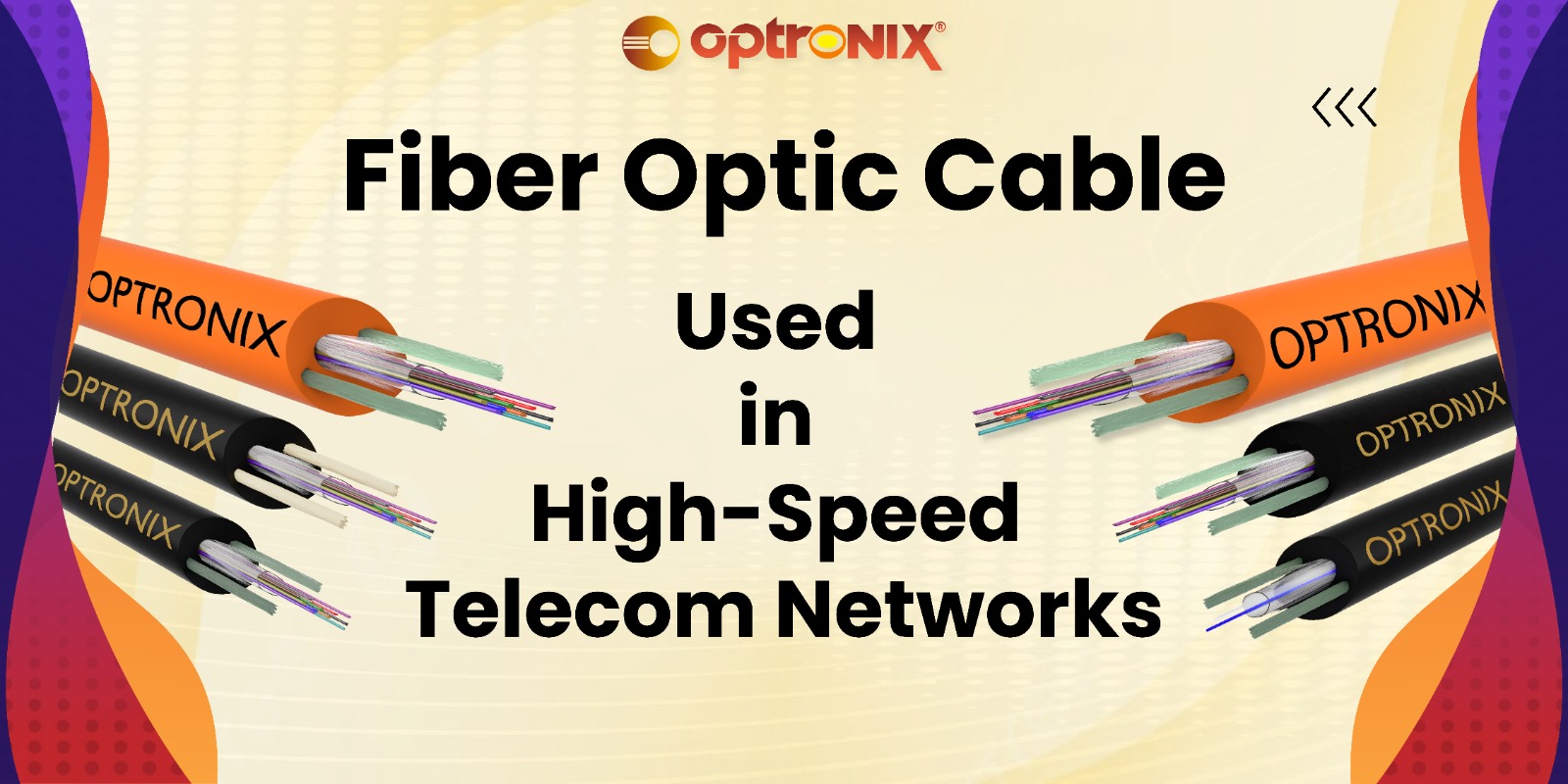
What Is Fiber Optic Cable and How It Works? The Invisible Highway of Data

In a world driven by instant communication and massive data streams, the humble cable carrying the internet to your home, office, and mobile device is one of the most important pieces of modern technology. For decades, copper wires were the standard, but they are rapidly being replaced by a far superior technology: fiber optic cable.
Fiber optics is the true backbone of the digital age, capable of transmitting colossal amounts of data at the speed of light. But what exactly is this cable, and how does it manage such an incredible feat?
Defining the Digital Lifeline: What is Fiber Optic Cable?
A fiber optic cable is an assembly similar to an electrical cable, but instead of transmitting electrical signals through metal wires, it transmits light signals through thin strands of highly pure glass or plastic, known as optical fibers.
These glass strands are incredibly thin about the diameter of a human hair. A single fiber optic cable often contains dozens or even hundreds of these individual fibers, each capable of carrying an independent data channel.
The Basic Structure of an Optical Fiber
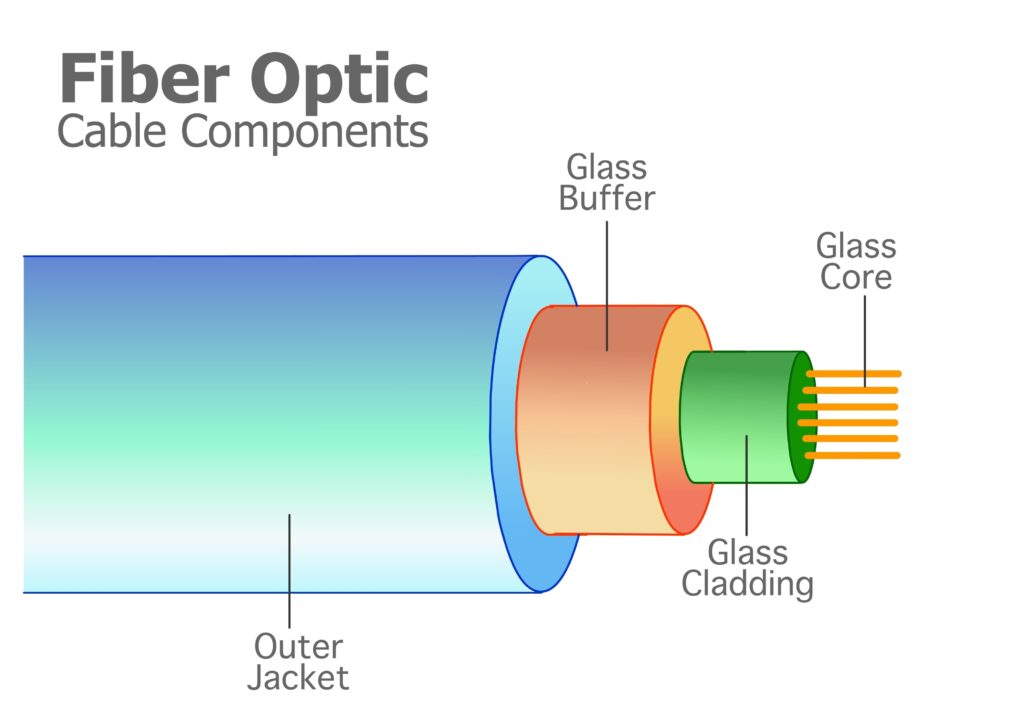
Every single optical fiber consists of three main components:
- Core: This is the innermost layer and the light-carrying element. It is typically made of high-purity silica glass and has a higher refractive index.
- Cladding: A layer surrounding the core, also made of glass or plastic, but with a lower refractive index. This difference in the refractive index is what allows the fiber to work.
- Buffer Coating/Jacket: A protective plastic layer surrounding the cladding, designed to shield the delicate fiber from moisture, crushing, and other physical damage.
The Physics Behind the Speed: How Fiber Optic Cable Works
The magic of fiber optic cable lies in a fundamental principle of physics called Total Internal Reflection (TIR).
1. Signal Generation and Encoding
Data (like a website, a video, or an email) is electrical in nature. Before transmission, this electrical data is converted into pulses of light using a laser or an LED transmitter.
- A digital ‘1’ is represented by a pulse of light.
- A digital ‘0’ is represented by the absence of a light pulse.
2. Total Internal Reflection (TIR)
The light pulses are injected into the fiber’s core. Due to the precise difference in material properties (refractive indices) between the core (high index) and the cladding (low index), the light signal never escapes the core.
When the light strikes the boundary between the core and the cladding at a shallow angle, it is reflected back into the core, essentially bouncing its way down the fiber like water through a pipe.
This constant reflection allows the light signal to travel enormous distances. sometimes over 100 kilometers with minimal loss in signal strength, ensuring that data is delivered quickly and accurately.
3. Signal Reception and Decoding
At the receiving end, the light pulses are captured by a device called a photodetector or an optical receiver. This device converts the light energy back into its original electrical signal, which your computer, phone, or router can then understand as usable data.
The Advantages of Fiber Over Copper
Why has the world invested trillions in replacing copper with glass? The advantages are profound:
| Feature | Fiber Optic Cable | Copper (Twisted Pair) Cable |
| Bandwidth/Speed | Extremely High (Terabits per second potential) | Limited (Megabits to low Gigabits per second) |
| Transmission Distance | Very Long (over 100 km without boosting) | Short (around 100 meters for high speeds) |
| Immunity to Interference | Excellent (Not affected by EMI/RFI) | Poor (Highly susceptible to electromagnetic noise) |
| Security | High (Tapping the line is detectable) | Low (Easier to tap and intercept signals) |
| Weight | Very Light and Thin | Heavy and Bulky |
The Two Types of Optical Fiber
There are two primary categories of fiber used today, each suited for different applications:
- Single-Mode Fiber (SMF):
- Core Size: Very small core (typically 9mm).
- Function: Only one mode (path) of light can travel down the core.
- Application: Long-haul networks, deep-sea cables, and primary data backbones where distance and speed are critical. Requires expensive laser light sources.
- Multi-Mode Fiber (MMF):
- Core Size: Larger core (typically 50mm or 62.5mm).
- Function: Multiple paths (modes) of light can travel down the core.
- Application: Shorter distances, such as within a data center, an office building, or a local network. Uses less expensive LED light sources.
Conclusion: The Foundation of Modern Life
Fiber optic cable is not just a faster way to browse the web; it is the fundamental infrastructure enabling global commerce, telemedicine, cloud computing, and the exponential growth of data. By leveraging the simple yet elegant physics of light, these thin glass strands have created the invisible highway that powers our modern digital lives.